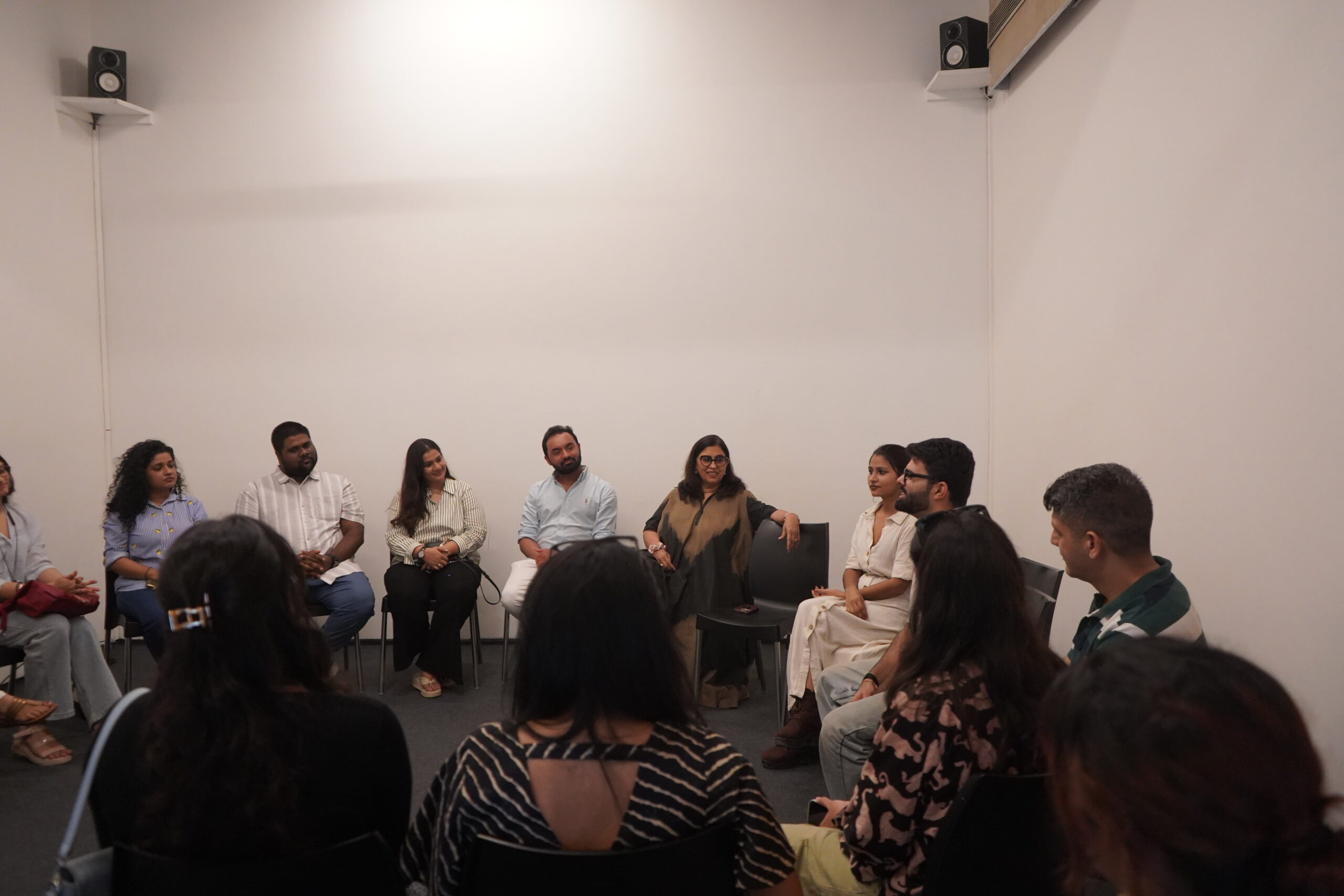

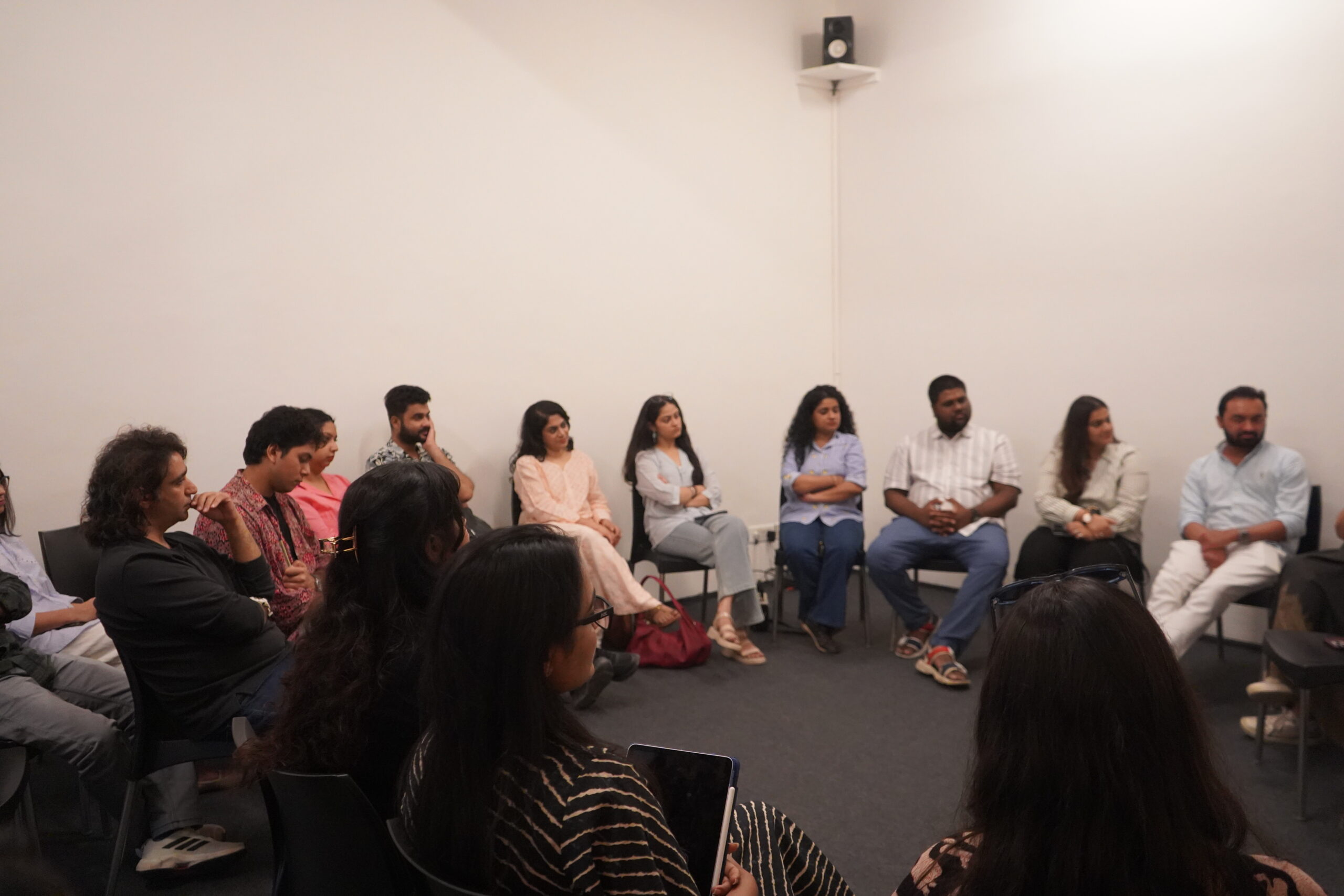
On a Sunday evening, 30 creative practitioners gathered together in Khoj’s Project Space for the Real Talk event organised by Orange Chowk, hosted by Khoj Studios. Orange Chowk is a community of 9000+ creatives across India: designers, artists, founders, cultural builders. Their invitation highlighted the need for such gatherings to examine the value of uncertainty in the creative industries and experimentation as the work and process itself. They invited Pooja Sood, director of Khoj Studios, to lead the conversation on creating space for experimentation, Khoj’s journey so far, and sharing insights on the road ahead.
The session started with a quick round of introductions from the room; the audience came from a range of backgrounds- designers, architects, visual artists, Gen AI consultants, creative strategists, game designers, academia, etc. Many were moving from one industry to another, some working in the corporate sector and others looking to shift roles. Ayush, founder of Orange Chowk, oriented the session by emphasising that while called a “Real Talk,” the format of the session would be more conversational and people were encouraged to ask questions. The theme of the conversation was on the art of observation, as a common theme across creative industries and the different approaches they take towards the same. Throughout the conversation, Pooja traced Khoj’s lens of observation as keeping our ear to the ground, putting out propositions for shared learning and shared anecdotes and learnings from different programs over the year, including Coriolis Effect, Art & Technology and Art & Ecology, etc.
Pooja Sood began by sharing her background as a science student, moving on to getting an MBA, and how an art history degree shaped her worldview and made her look at art with genuine curiosity. She traced her early journey with her work at Eicher Gallery in Delhi, where she had the opportunity to curate the first exhibition in India with Pakistani artists, to talk about the Partition, unpacking the silence around it. Khoj began later, where artists came together to understand how South-South connections could be formed and built. Residencies were introduced, and after the Khoj building came up, the organisation sought to set up similar residency models around India and kept strengthening the Indian art ecosystem. Pooja stressed Khoj’s values as leading the organisation through good and hard times, especially keeping their ear to the ground and listening to the artists. Presently, as Khoj approaches thirty years, the team wishes to continue building relational infrastructures and keeping the artist at the centre. She shared some of the programmes that Khoj has organised in the past, keeping such values in mind, including Coriolis Effect, grounded in the African demographic in Khirkhee and the everyday relationships and negotiations through artistic lenses, Art & Tech as a thematic, and how the Bodies-Machines-Publics residency set out a proposition for artists to come in and critique tech, work on the effects of data banks, facial recognition systems and thus to encourage the public to bring up such questions.
Afterwards, a question-and-answer session began where the audience engaged enthusiastically. A person quoted Scratch, an open-source software which helps children learn coding, and how project-based learning is preferred in many systems over structure, thus how much Khoj residencies are structured. Pooja shared that while the cohort is selected based on demographic diversity, programming is based on their practice and interests when they come to Khoj. The discussions explored the leap of faith in being a creative, the debate between feeding the soul and feeding the body, the differences between visual art and design as industries, how one raises questions and brings insights on societal issues, whereas one is more solution-oriented. On an ending note, the room spoke about how art can be thought through the lens of philosophy; one may choose to engage in it for its intrinsic values or its commercial value. The evening wrapped up with more such conversations paired with chai and samosas in the Khoj Canteen. The event brought in new and curious audiences, and similar collaborations could be fruitful for short- and long-term engagements, ideas, and increasing Khoj’s network of creative practitioners.


