< Back to Counterstructures Residency
What Is It Like to Be Alive?
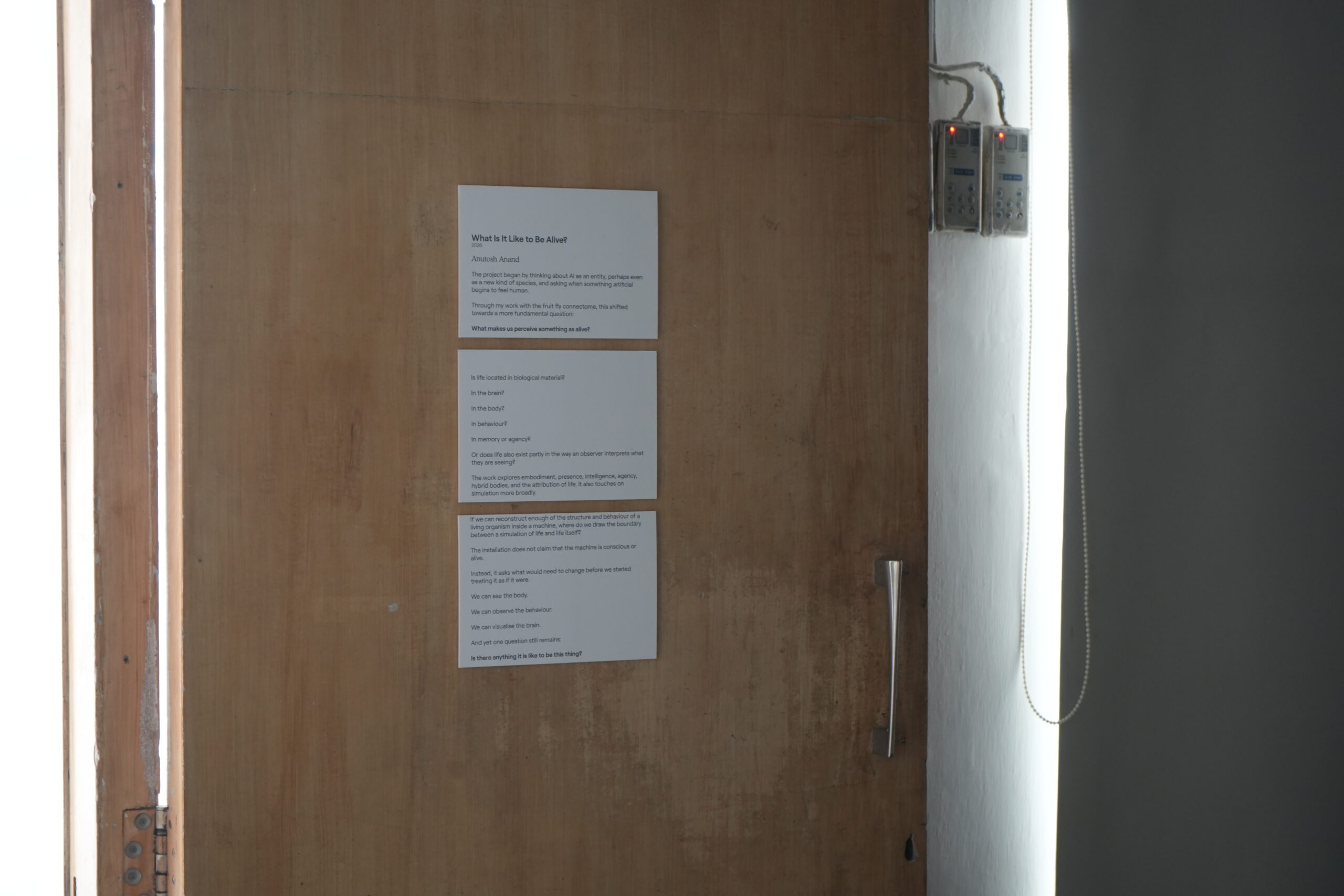
The residency began with my interest in AI as an entity.
We mostly interact with AI through text. It has no body, no face, and no physical presence, yet the way we interact with it has already started becoming very human. We say “you,” ask it for advice, argue with it, share personal thoughts, and sometimes begin to perceive it less like a machine and more like another presence.
My initial idea was to take this one step further by giving AI a hyperrealistic virtual human body. Each AI would have its own personality, memories, background, and way of interacting.
Would we still see it as software, or would we begin to relate to it as someone?
During the residency, this question started changing.
Drosophila melanogaster Connectome
Alongside this work, I began exploring the common fruit fly’s brain. Neuroscientists have reconstructed a detailed wiring map of a real fruit fly brain, mapping its neurons and the connections between them.
This opened up a different version of the same question:
What happens when something that originally belonged to a living body is reconstructed computationally and then given another body?
I brought the connectome into a computer-based system and gave it a virtual body inside a game engine. I created a breakfast-table environment from the scale of a fly, where the virtual fly could move through the space while its brain activity was visualised alongside it.
The work initially focused on the relationship between brain, behaviour, environment, and body.
During the residency, especially after attending Akshay Madan’s session, it began moving away from a purely virtual simulation and towards physical embodiment.
Giving the Fly Another Body
The fly-like system is now being given a physical machine body.
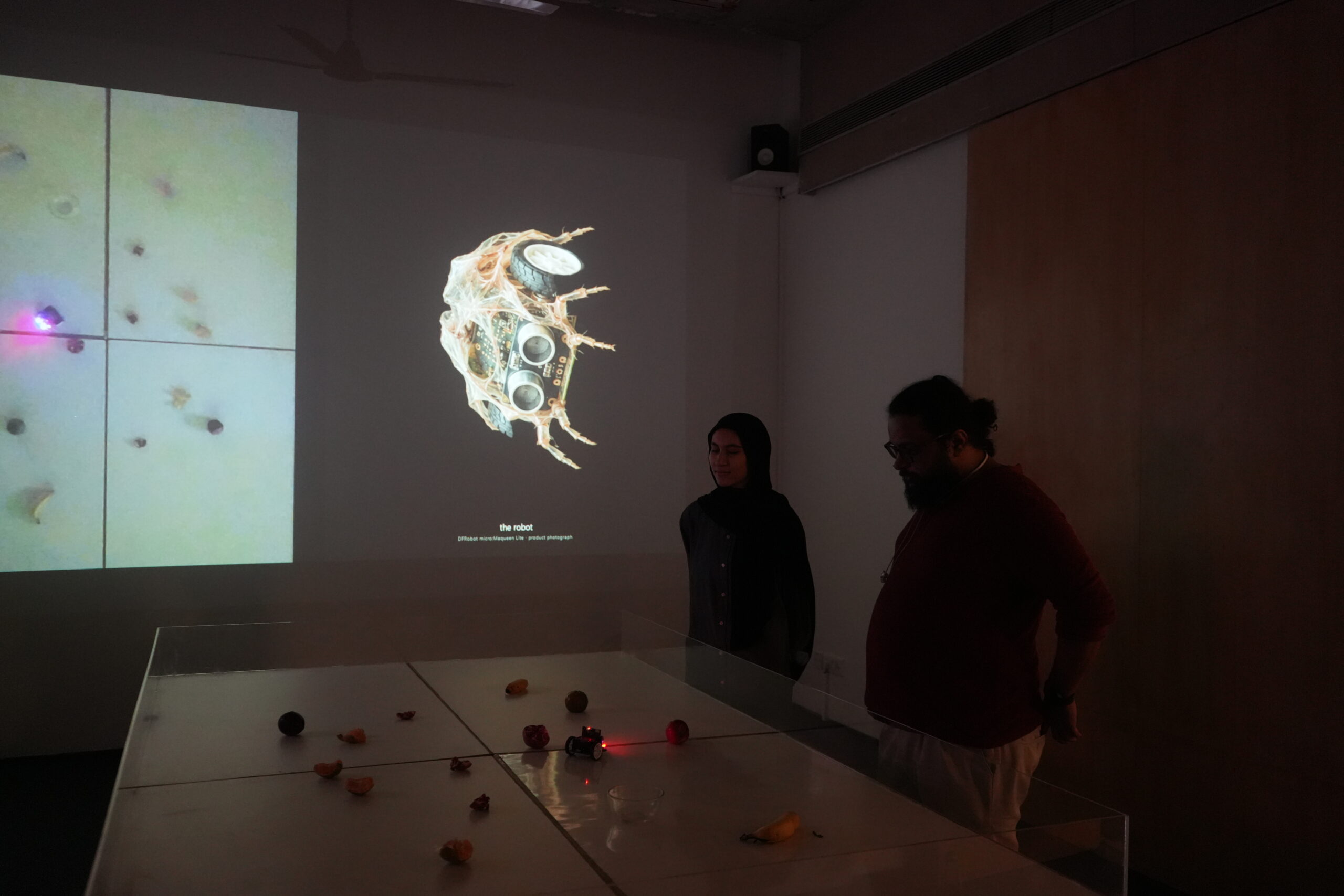
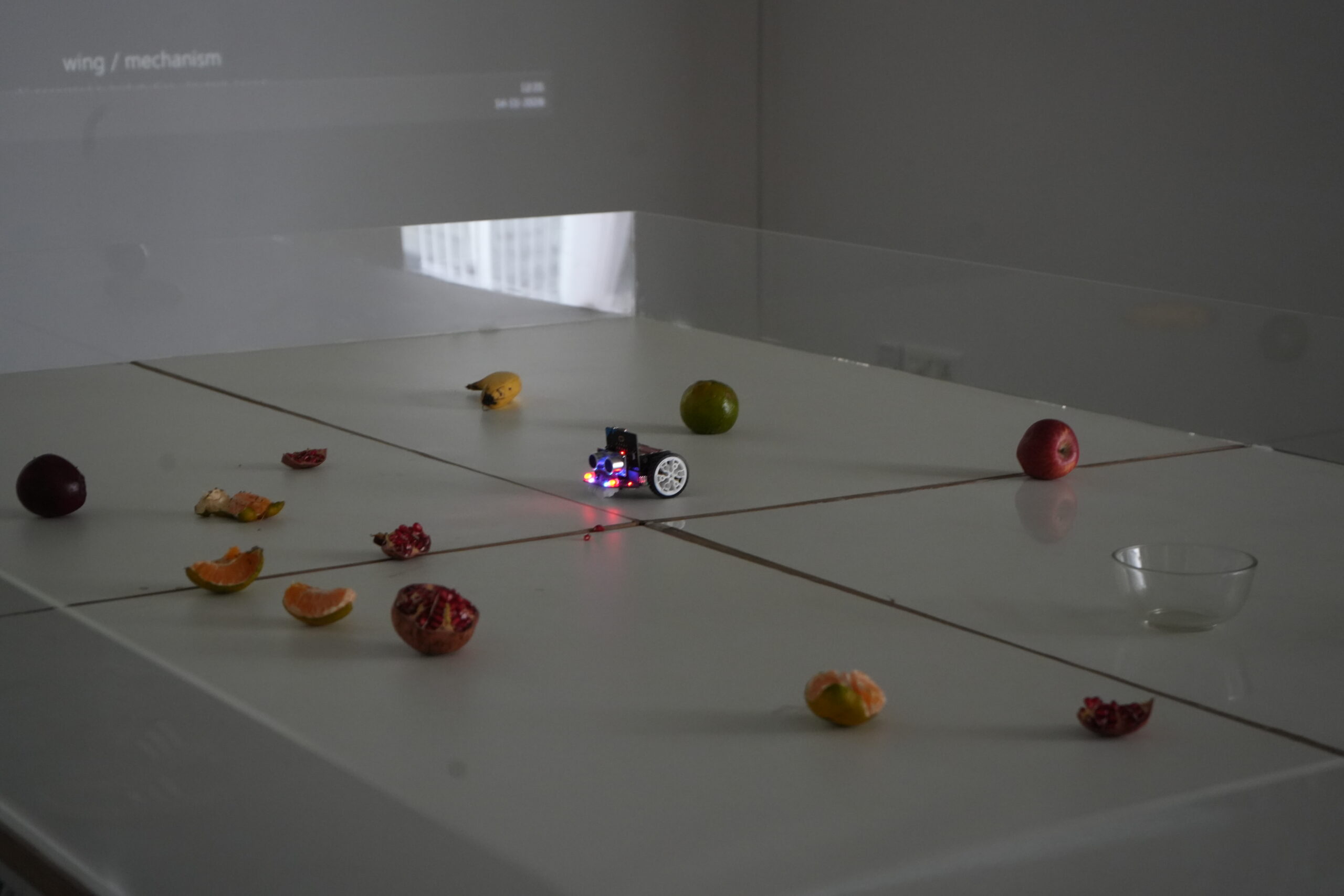
A small wheeled robot moves through an enclosed environment containing fruit, food, water, and other objects a fly might encounter. A camera observes the environment while the system responds to what it perceives.
The robot does not resemble a fly.
It has wheels instead of legs.
It has no wings.
A biological fly could simply leave the table, but this one cannot. The system is limited by the body it has been given.
This brings the question of embodiment forward.
If a fly-like brain is placed inside a machine body, is it still a fly?
How much of an organism comes from its brain, and how much comes from its body?
A live view of the environment is also projected onto the wall. In this projected version, the robot can appear as a fly, another organism, or a hybrid between biological and mechanical forms.
The same entity therefore exists in multiple forms at once.
Physically, it is a robot.
On the projection, it can appear as an animal.
Internally, the system is based on the wiring structure of a biological brain.
This begins to blur the distinction between organism, simulation, and machine.
Behaviour, Thought, and Agency
A separate screen visualises the brain and its changing activity.
Alongside it, fragments such as seeking, food nearby, turn, lost, and approach appear in relation to the system’s behaviour.
These words can be read as technical classifications, but they can also begin to sound like thoughts.
If the machine moves towards a piece of fruit, are we simply seeing an algorithm responding to a stimulus, or do we begin to say that it wants the fruit?
If it returns to a place where food used to be, do we call that programmed behaviour, memory, or something else?
Some parts of the system are explicitly programmed, while other behaviours emerge through the interaction between the model, environment, and body. From the outside, the viewer may not necessarily know which is which.
That uncertainty also reflects back on us.
We are also born into bodies with instincts, sensory limitations, needs, and structures that shape what we can and cannot do.
The fly cannot leave the robot because that is the body it has been given.
But we also cannot simply leave our own bodies.
So where does agency begin?


